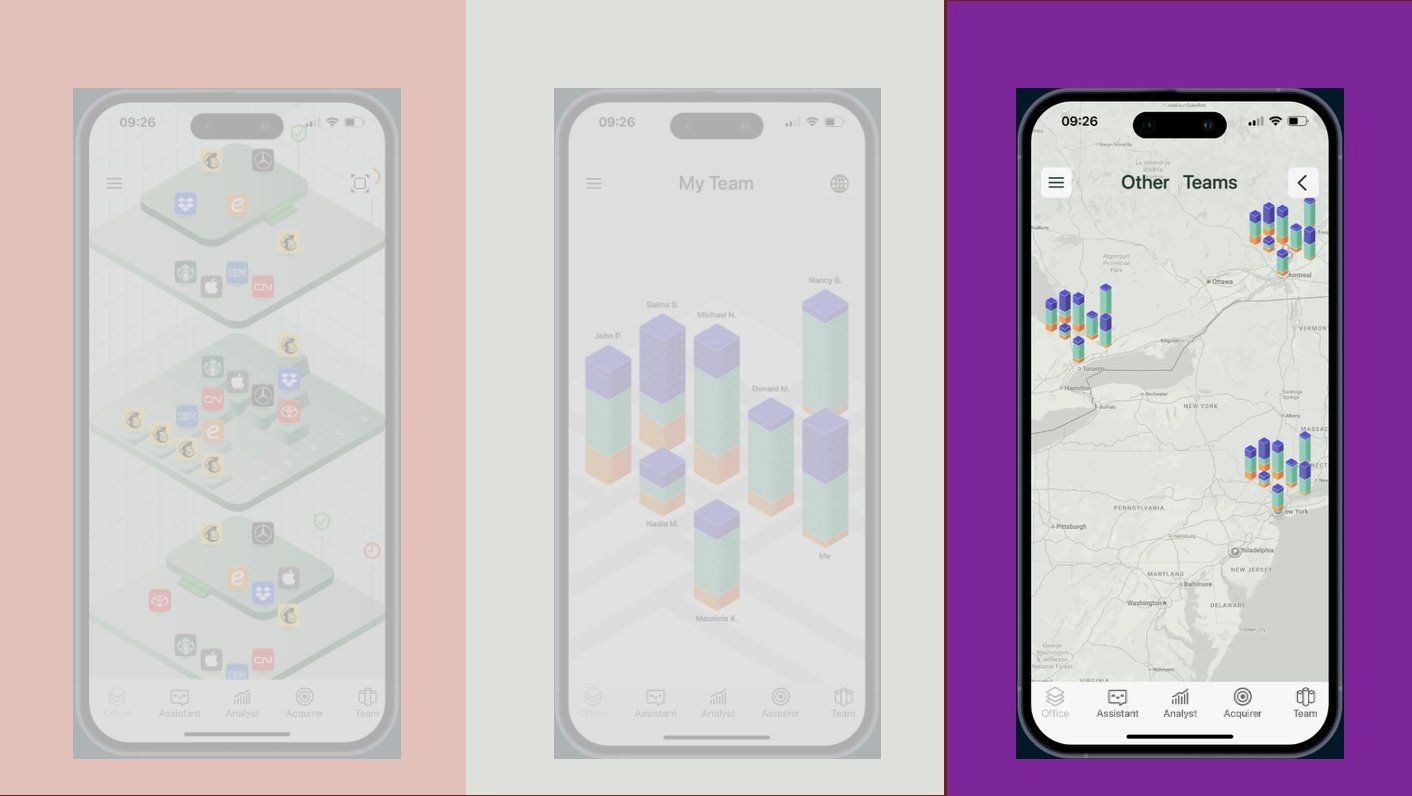
Each team appears as a living cluster, located where the team actually operates. Within each cluster, every building represents an individual banker, and building height evolves continuously, reflecting client load, prospect activity, deal intensity, and the impact of active team challenges.
This shared visual language gives leadership an immediate sense of focus, momentum, and imbalance across teams, without relying on reports, status meetings, or interpretation layers.
Leaders can interact directly with an AI layer to ask questions about any individual, team, or region in real time. The system highlights emerging opportunities and potential risks as they form, enabling leadership to disseminate insights or address exposure before patterns spread across the organization.
Execution is not only visible in the moment. Variations in building height can be compared across periods, revealing how activity, focus, and strategic initiatives evolve over time.
Leaders can communicate directly with each employee through their personal Assistant Agent. Meetings are added to calendars, priorities are clarified, and new to-do items are inserted directly into individual workflows. Communication moves from announcement to execution without coordination overhead.
Through the Analyst Agent, leadership can communicate questions at scale. Leaders request analysis on specific clients, portfolios, or defined lists, and ask teams to explore risks, opportunities, or emerging themes. Insights are built on shared data and returned in a consistent format, enabling clearer discussion and faster alignment.
With the Acquirer Agent, leadership communicates prospecting priorities and objectives directly into action. Target segments, focus areas, and outreach intent are translated into concrete execution, keeping prospecting efforts aligned with strategic direction across teams.

Leaders use podcast-style communication to speak directly to teams with context and nuance. An AI layer first suggests discussion points based on past activity, positive and negative outcomes, surprises, and gaps between expectations and reality.
Leaders then refine, adjust, and personalize this content with their own perspective and tone. This allows leadership to address what worked, what did not, and why, while remaining authentic and grounded in real execution.
Leaders can also be interviewed to communicate new objectives for the next period, framing priorities and direction in their own voice so intent is clearly understood across teams.

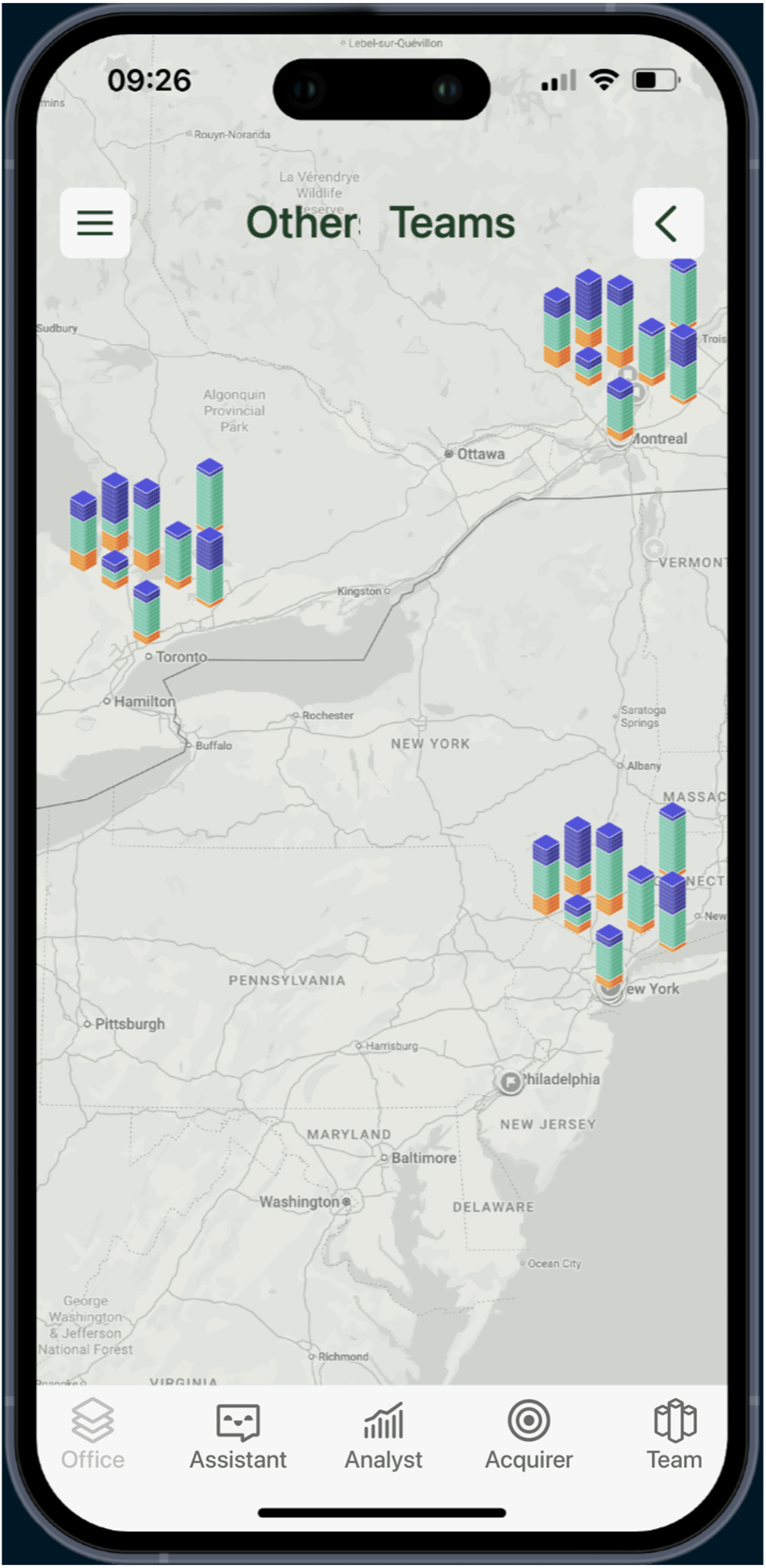
Milestone races allow leadership to formalize priorities with full transparency, using objectives that reflect how work actually happens. Unlike traditional CRM targets, these milestones are not limited to a narrow set of KPIs.
Leaders can define milestones around weekly call volume, new prospects, client visits, deals initiated or closed, or any activity that matters in a given period. What leadership chooses to measure becomes visible, shared, and comparable across teams.
Progress is reflected directly in execution views, making priorities tangible without additional reporting. Milestones do not replace judgment. They provide a clear, visible frame that helps teams align effort with what leadership wants to emphasize.
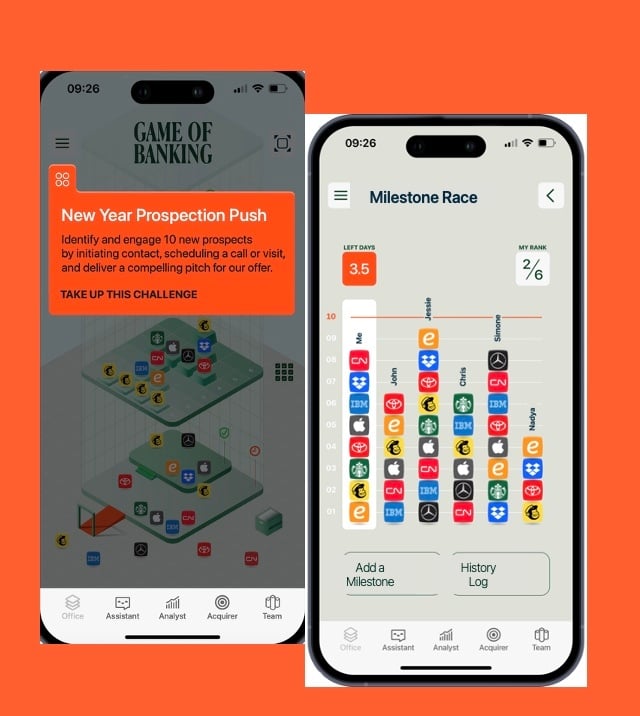
Progression quests allow leadership to define sequences of objectives that must be achieved in order. Rather than focusing on isolated milestones, these sequences ensure teams remain aligned on the full path toward a strategic outcome.
Everyone shares the same ultimate objective, while clearly understanding the steps required to get there. This structure prevents teams from optimizing minor milestones in isolation and keeps execution connected to the bigger picture leadership intends to drive.
Progression quests also make it possible to recognize and celebrate meaningful progress along the way, even before the final objective is fully achieved. Leadership can acknowledge momentum, learning, and execution quality at each stage, reinforcing focus and discipline throughout the journey.
For example, during an industry conference, leadership can define a progression from new contacts acquired, to new LinkedIn connections, to calls booked, on-site client visits, loan proposals issued, and ultimately new loans added to the portfolio. Each step matters, and each step is visible.
Team voting enables leadership to formalize recognition around the achievements that matter most. Leaders define the voting themes, and teams collectively recognize performance, judgment, and impact, not just volume or output.
Votes can focus on Treaty of the Month, most complex deal closed, best deal saved from competition, most critical situation resolved, or any achievement leadership wants to highlight. This allows unique contributions to surface that traditional metrics often miss.
Team voting creates a shared culture of recognition where exceptional moments are visible, celebrated, and remembered. It strengthens team cohesion, reinforces values, and builds identity around what leadership truly considers meaningful performance.